Category Archives: Reader Request

13 Ways of Looking at a Fat Girl: If I had a less complicated relationship with ‘fat’

I requested Mona Awad’s 13 Ways of Looking at a Fat Girl because I wanted to be the kind of person who could read a book about body image and body size and not have it be a fraught experience. Alas. I am not that kind of person (yet) (ever). So my review here is coloured (aren’t all reviews?) by my experience hating-learning-and-now-force-loving my body (“Force-loving” your body is my term for my practice of aggressively defending my body’s right to do whatever it wants, even while I have niggling doubts. Like I can force body postivity on myself with a combination of determined repetition “soft bodies are beautiful!” and strategic disavowal “diets are tools of the capitalist patriarchy!” and yet somehow am always left wondering about the why I’m running 5km at 5am: where lies the border between enjoying an active body and policing it?).

I DIGRESS.

The book, the book. So probably it has 13 chapters. That would make sense with the title. It follows Elizabeth/Liz/Lizzie/Beth over her lifetime of hating her body. Born to a fat mom, Lizzie grows up fat. The first chapters are her as a teenager experiencing a fat body in a world that it still very okay with fat prejudice. In fact, part of the project of the novel seems to be exposing just how pervasive this prejudice is, and the societally sanctioned cruelities that accompany. As Lizzie ages she experiences different sizes of body and the way her body is read and interpreted by others. That her own internalized sense of self is at odds with how other people see her should be no surprise to anyone who has experienced an eating disorder or body dysmorphia. Or you know, has been a person in the world at all, really.

It has some fabulously rendered scenes made sharp for this reader by poignant details balanced against and occasionally undercutting, but often perpetuating, stereotypes about how women treat themselves and one another. The relationships between groups of women and food is explored with nuance: not just the dynamics of a social gathering, but the ways friendships are made (and broken) by body size and the (innumerable) activities that surround keeping a body just so. Lizzie’s frequent inability to see past how other women are presenting themselves in relation to food, and how she allows (all) her relationships to be shaped by what, how and who is eating is as sad as it is familiar.

So if you’re a person who has experienced a fraught relationship with body or food I’d suggest reading this one for the moments of recognizing yourself and feeling understood and seen. But more if you’re a person who has an untroubled relationship with food or body (who *are* you and how did you get to be this way?!) I’d urge you to read this one as it offers a – if only from one, fictional perspective – view into a life led in body distress. And might lend you some tools – and empathy – for encountering bodies differently.

Leave a comment

Filed under Canadian Literature, Fiction, Reader Request

Cottage Reads 2015

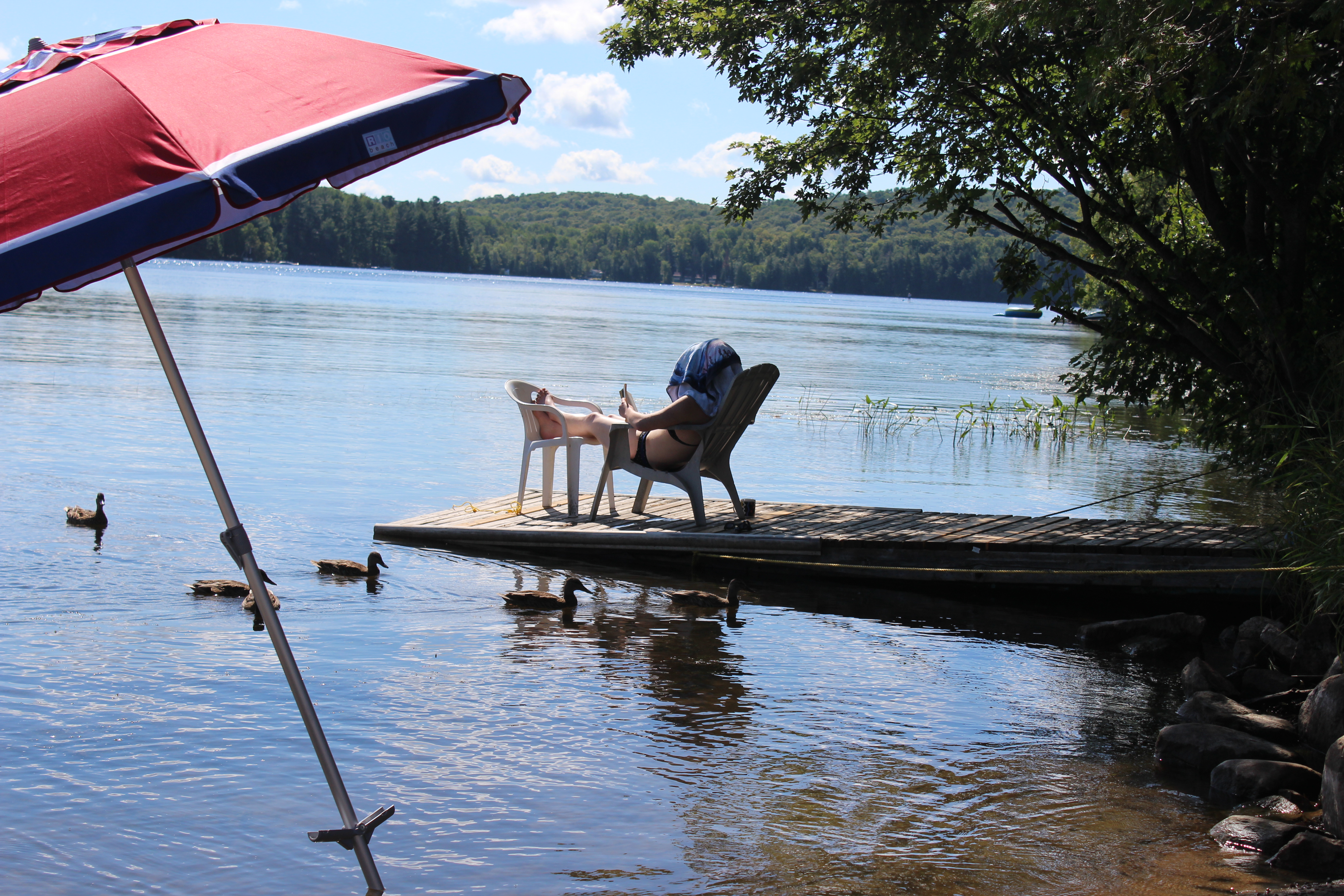
I’m of the privileged few able to take a week holiday in the Muskokas each summer. This holiday is shared with my family (though my partner has fewer weeks of vacation and was working) and so involves a combination of swimming, hearts tournaments, making ‘suggestions’ about how to eat/sleep/parent/live and reading-in-proximity. It was newly wonderful this year as my nephews are old enough now to turn the pages of their board books, and to make gleeful noises at the appropriate places in The Paperbag Princess. In my family, reading is both a solitary activity and a shared practice. Count me privileged in two ways then: spoiled in the ways of cottage; spoiled in the ways of books.

I probably read more than the rest of my family this past week because I’m a grumpy introvert and I insist both on shared reading time and hours (and hours) of time alone on the dock with a book. But even with this additional solo-time, I read less this year than in the past. I attribute this ‘lost’ time to the bountiful addition of time shared with E. and M. as we screamed up and down hallways, paddled in the shallows and practiced over and over and over saying “Auntie E” (it didn’t work).

So what did I read? And what would I recommend taking on your own cottage vacation (should you be lucky enough to get one)?

The Pope and Mussolini – David Kertzer

My mum has been going on about how good this book is for ages. It’s the non-fiction account of the rise of fascism in Italy and the relationship between the Pope and Mussolini that made this rise possible. I don’t read much non-fiction (as you know) and would never have picked this one up without mum’s insistence. And I didn’t finish it because a) I didn’t care about the story b) that’s the only reason. There were certainly narrative elements that helped this reluctant non-fiction reader to stay interested – neat character descriptions and conflict – but on the whole I just… didn’t care.

The Twelve Tribes of Hattie – Ayana Mathis

Despite being more short story collection than novel, I really enjoyed this one. Each chapter follows a different child of Hattie, with Hattie making her own appearances at different points. The first chapter that narrates Hattie’s experience parenting two sick twins is incredibly moving. And sets the stage for a series of provocative, emotional and taught explorations of growing up, class, race, sexuality… it’s got a lot going on. And where you might expect this range of thematic interest to lead to less depth, it doesn’t (I talked about the same with The Bone Clocks – this book isn’t nearly as good at That Great Book, but it is good).

The Unlikely Pilgrimage of Harold Fry – Rachel Joyce

This one reminded me a lot (a lot) of A Man Called Ove. The same sort of whimsical tone, the same exploration of what makes meaning in life, the same absurdist plot premise (in this case our protagonist is walking the length of England to ‘save’ his once friend from cancer), the same easy enjoyment and sense of contentment on conclusion. It’s a book that wants you to feel good about yourself, about life, about connections to others, about the possibility for late-life change, for reconciliation. It’s a feel gooder if I’ve ever read one.

The True History of the Kelly Gang – Peter Carey

I think I remember this being one of M.’s favourite books and I always meant to read it for that reason. Why did I wait so long? What a delight. A romp through history. The historical fiction ‘true history’ of Ned Kelly presented as autobiography (so cue my favourite things: historical fiction & metafiction). It’s an at time playful, at times painful look at the relationship between state and criminal and our efforts to memorialize ourselves (and to make our lives meaningful). Gosh, and the writing is so good.

That’s it for my summer reads. I’m now gearing up for fall teaching and book clubs. If you have more recommendations or requests, you’d best get them in soon. Oh. That’s not true. I’m waiting for my advanced review copy of the new Jonathan Franzen to arrive. (I can’t wait) (even though I’m waiting). (I’m so excited) (even though I’m usually a Franzen complainer). (end post). (now).

1 Comment

Filed under Fiction, Prize Winner, Reader Request

Station Eleven: Why are you having a baby when the world is ending?

I’ve wanted a baby since my lady bits started twitching in my late twenties. I’ve been asked – and had trouble replying – why I want a baby. It’s a good question, and one we (collective humanity we and my partner-and-me-we) should probably be able to answer before we go ahead and have one. Enter me reading Emily St John Mandel’s (excellent) Station Eleven and feeling ever more sure that the world as we know it is ending, and that having a baby is… [enter your adjective]: risky, selfish, hopeful, terrifying, absurd, brave. Sure, when I was born in the 80s my parents must have felt a similar sense of foreboding: the Cold War threat of nuclear annihilation probably made it feel pretty scary to have a kid. And without the same frame of reference, I can’t be sure, except the arrival of disasters brought on by global warming makes the ‘threat’ not a possibility, but a reality.

So what does my baby-end-of-the-world-angst have to do with Station Eleven? The book narrates the post-apocolyptic world of a mix-matched cast of characters for whom the mantra “Survival is Insufficient” prompts them to not just survive, but to make and appreciate art, to maintain friendships and romances, and to form complicated relationships with ideas of past and future. It also gave this reader the scope and space to consider the [enter your adjective] of being a parent in any world, the massive responsibility and the abnegation of self called for by culture and circumstance (am I more or less likely to have a baby now? Time will tell).

With characters scattered in time and geography, the novel moves back and forward as readers are invited to piece together the events surrounding the collapse and the journies and connections of different characters (much, I might add, as one of these characters might be positioned to try to make sense of their world). We witness a magnificiently drawn setting of winter Toronto (really, not since the mostly wretched The Night Circus have I enjoyed a setting quite so much) and scenes along the north-east seaboard of North America (less brilliant than that of Toronto). Our characters are a little uneven in how successfully they’re drawn, but for the most part their motivations are well grounded in past events and rich personalities. (I would add that the narration of the lives of these characters ‘before’ the collapse is excellent – our knowledge of the imminanent end to their existence through the juxtaposition of their present adds urgency and poignancy to already great narration).

The past is captured in the creation and curation of the “Museum of Civilization” – an effort on the part of a few characters to preserve the history of the world that was lost, and to teach future generations about the cultures destroyed through their objects. The Museum is contrasted with characters who have ‘lost’ memories of the first years after the collapse. A sense that while remembering and presevation is a critical part of rebuilding culture, so too, an active forgetting (of the violence and isolation, we presume) is required for the same.

The future gestured to at the end of the novel is one of an expansion of connectivity (the lights go on again), the spread of ideas (the creation of a newspaper) and expanded travel (the networks of roads grow). It is a future, though, predicated on the tenacity and hope of its populace. The willingness of each character individually, and the groups collectively, to learn from one another and to trust one another (as in newspaper interviews and expansions of communities).

More than the (truly excellent) video game The Last of Us, the TV series The Walking Dead and the host of other post-apocolyptic futures we’ve encountered in recent years, Station Eleven calls on us to consider not only the everyday marvels and luxuries that surround our priviledged lives, but the threads of civilization that make a human life worth living: art, community, a connection to the past, a sense of hope for the future.

4 Comments

Filed under Bestseller, Book Club, Fiction, Mystery, Prize Winner, Reader Request

Boy, Snow, Bird: Half-read rejections

I wish the back of the book hadn’t given away the turning point of the novel. But it did, and so I will, too: Helen Oyeyemi’s Boy, Snow, Bird follows our protagonist – Boy – as she flees the home of her ratcatcher father, marries a jeweller with a daughter, Snow (“white as snow”), has a baby – Bird – who is black. Her husband, Arturo, has been passing as white. That’s the first half of the story. The rest of the book is taken up with how this trifecta of Boy, Snow, Bird experiences the world, family and identity. Mixed up with the questions of what to do with her own sense of familial history and desire (what are the scales of secrets?).

I didn’t love the novel. I wasn’t taken with the quasi-mystery and fantastical tone. I didn’t particularly like Boy, and so found it hard to care about the complexities of being her. Maybe I’d have liked the book more narrated from Snow or Bird? Actually, to be honest, I stopped reading three quarters of the way through and so maybe there is a sudden shift in point of view that makes the whole thing that much better? I’ll never know (unless you tell me in the comments!), but I do know that it wasn’t the book for me. (Though if you take your reviews from the New York Times – it’s the book for many, many others).

Leave a comment

Filed under Book I'll Forget I Read, Fiction, Reader Request