Tag Archives: Books recommended

Cottage Reads 2015

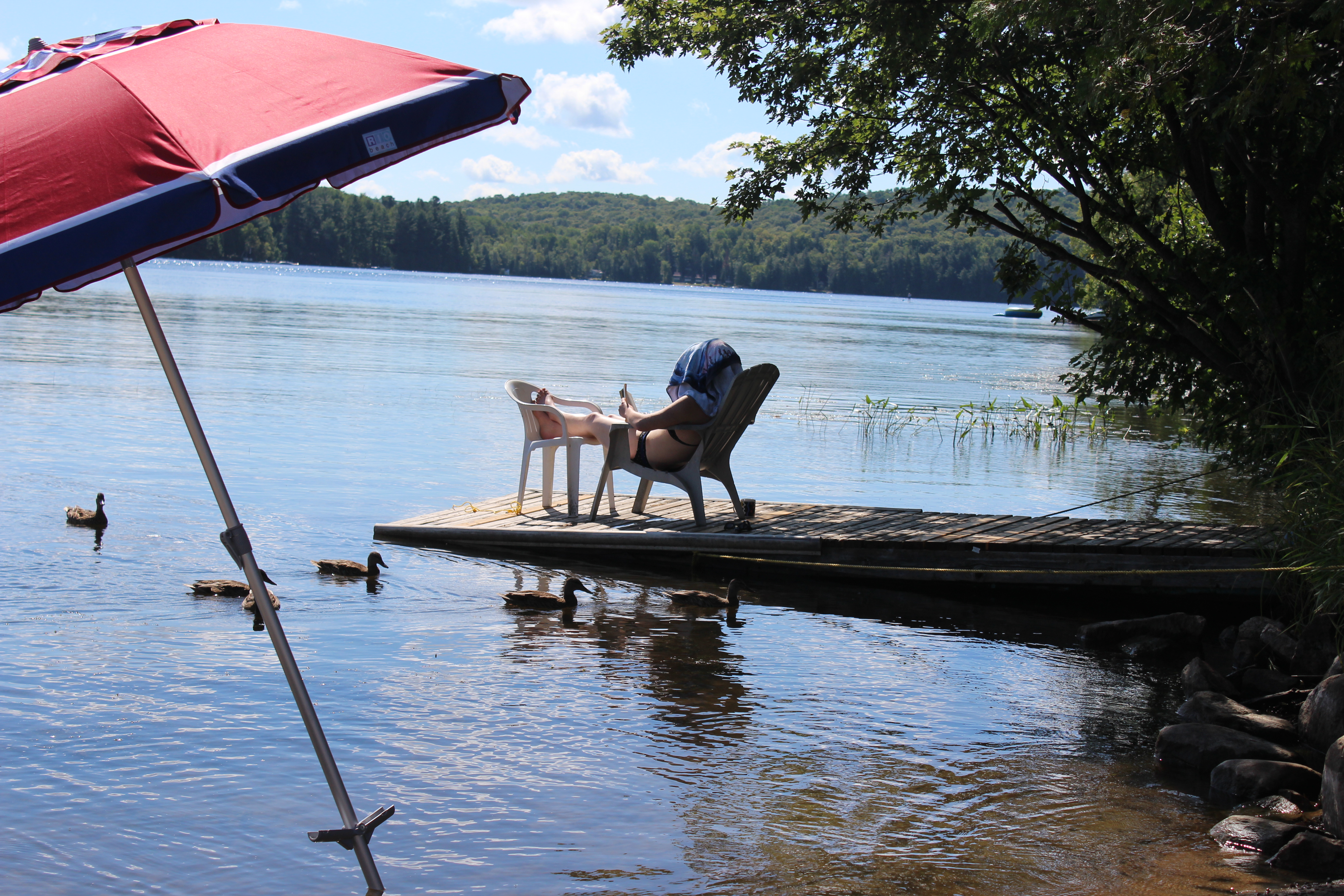
I’m of the privileged few able to take a week holiday in the Muskokas each summer. This holiday is shared with my family (though my partner has fewer weeks of vacation and was working) and so involves a combination of swimming, hearts tournaments, making ‘suggestions’ about how to eat/sleep/parent/live and reading-in-proximity. It was newly wonderful this year as my nephews are old enough now to turn the pages of their board books, and to make gleeful noises at the appropriate places in The Paperbag Princess. In my family, reading is both a solitary activity and a shared practice. Count me privileged in two ways then: spoiled in the ways of cottage; spoiled in the ways of books.

I probably read more than the rest of my family this past week because I’m a grumpy introvert and I insist both on shared reading time and hours (and hours) of time alone on the dock with a book. But even with this additional solo-time, I read less this year than in the past. I attribute this ‘lost’ time to the bountiful addition of time shared with E. and M. as we screamed up and down hallways, paddled in the shallows and practiced over and over and over saying “Auntie E” (it didn’t work).

So what did I read? And what would I recommend taking on your own cottage vacation (should you be lucky enough to get one)?

The Pope and Mussolini – David Kertzer

My mum has been going on about how good this book is for ages. It’s the non-fiction account of the rise of fascism in Italy and the relationship between the Pope and Mussolini that made this rise possible. I don’t read much non-fiction (as you know) and would never have picked this one up without mum’s insistence. And I didn’t finish it because a) I didn’t care about the story b) that’s the only reason. There were certainly narrative elements that helped this reluctant non-fiction reader to stay interested – neat character descriptions and conflict – but on the whole I just… didn’t care.

The Twelve Tribes of Hattie – Ayana Mathis

Despite being more short story collection than novel, I really enjoyed this one. Each chapter follows a different child of Hattie, with Hattie making her own appearances at different points. The first chapter that narrates Hattie’s experience parenting two sick twins is incredibly moving. And sets the stage for a series of provocative, emotional and taught explorations of growing up, class, race, sexuality… it’s got a lot going on. And where you might expect this range of thematic interest to lead to less depth, it doesn’t (I talked about the same with The Bone Clocks – this book isn’t nearly as good at That Great Book, but it is good).

The Unlikely Pilgrimage of Harold Fry – Rachel Joyce

This one reminded me a lot (a lot) of A Man Called Ove. The same sort of whimsical tone, the same exploration of what makes meaning in life, the same absurdist plot premise (in this case our protagonist is walking the length of England to ‘save’ his once friend from cancer), the same easy enjoyment and sense of contentment on conclusion. It’s a book that wants you to feel good about yourself, about life, about connections to others, about the possibility for late-life change, for reconciliation. It’s a feel gooder if I’ve ever read one.

The True History of the Kelly Gang – Peter Carey

I think I remember this being one of M.’s favourite books and I always meant to read it for that reason. Why did I wait so long? What a delight. A romp through history. The historical fiction ‘true history’ of Ned Kelly presented as autobiography (so cue my favourite things: historical fiction & metafiction). It’s an at time playful, at times painful look at the relationship between state and criminal and our efforts to memorialize ourselves (and to make our lives meaningful). Gosh, and the writing is so good.

That’s it for my summer reads. I’m now gearing up for fall teaching and book clubs. If you have more recommendations or requests, you’d best get them in soon. Oh. That’s not true. I’m waiting for my advanced review copy of the new Jonathan Franzen to arrive. (I can’t wait) (even though I’m waiting). (I’m so excited) (even though I’m usually a Franzen complainer). (end post). (now).

1 Comment

Filed under Fiction, Prize Winner, Reader Request

Boy, Snow, Bird: Half-read rejections

I wish the back of the book hadn’t given away the turning point of the novel. But it did, and so I will, too: Helen Oyeyemi’s Boy, Snow, Bird follows our protagonist – Boy – as she flees the home of her ratcatcher father, marries a jeweller with a daughter, Snow (“white as snow”), has a baby – Bird – who is black. Her husband, Arturo, has been passing as white. That’s the first half of the story. The rest of the book is taken up with how this trifecta of Boy, Snow, Bird experiences the world, family and identity. Mixed up with the questions of what to do with her own sense of familial history and desire (what are the scales of secrets?).

I didn’t love the novel. I wasn’t taken with the quasi-mystery and fantastical tone. I didn’t particularly like Boy, and so found it hard to care about the complexities of being her. Maybe I’d have liked the book more narrated from Snow or Bird? Actually, to be honest, I stopped reading three quarters of the way through and so maybe there is a sudden shift in point of view that makes the whole thing that much better? I’ll never know (unless you tell me in the comments!), but I do know that it wasn’t the book for me. (Though if you take your reviews from the New York Times – it’s the book for many, many others).

Leave a comment

Filed under Book I'll Forget I Read, Fiction, Reader Request

My Struggle: Karl Ove Knausgaard and the Book You Should Be Reading

Don’t make the mistake I did and be caught off guard by this literary sensation. Go read the first installment (and then immediately all the others because you won’t be able to resist) of Karl Ove Knausgaard’s masterful, genius autobiographical series My Struggle. You probably already did. You’re probably one of the bazillions of people who have read the book and have read the countless articles extolling its virtues, its genius. And if you are, I say to you: Why didn’t you tell me earlier? Why did you let me wander around without this book? (to be fair, the book was endorsed on the Slate Political Gabfest ages ago, and was a book recommended by the fabulous L. – thanks!)

Okay, okay, so why so great? Why so necessary? Continue reading

Leave a comment

Filed under Erin's Favourite Books, Prize Winner, Reader Request

Reading in Newfoundland; or, How to Hit a Moose

Fear not. We didn’t hit a moose. But I also didn’t get as much reading done as I intended because my time as a passenger was spent on moose patrol, rather than reading. What? Oh, yeah, I was on holiday in Newfoundland for eleven days. Saw some whales, dolphins, puffins, no big deal. No moose spotted (happily), though we learned that in Gros Morne (where we spent the latter half of the trip) there are five moose per square kilometer. Symbols of Canadiana don’t come much more dense (ha ha).

In retrospect, with such a quintessential ‘Canadian’ vacation planned (though many of the Newfoundlanders we talked with disputed the ‘Canadianness’ of Newfoundland) I probably should have selected Canadian or Newfoundland-based novels. As it was, I took along several of your summer recommendations (thanks):

Annihilation, Jeff VanderMeer

Post-apocalyptic fantasy finds a group of four ‘explorers’, defined by their roles (the psychologist, the anthropologist, the linguist…), sent into a [anthropomorphic][animated][alien] landscape/environment to gather data. They encounter a range of challenges that are at once metaphoric and practical. With a nightmarish, oppressive atmosphere, the book asks the reader to consider the environment/natural world as both hero and antagonist to our present and our future. 3/5

Euphoria, Lily King

Following the anthropologist theme, Euphoria is based on the life of Margaret Mead with Mead fictionalized as Nell, her husband as Fen and their collaborator as Bankson. In addition to being one of the best love stories I’ve read in recent memory, the book is a thoughtful and nuanced exploration of ideas of ethnocentrism, positivism and colonialism. Principally narrated by Bankson, the retrospective time frame infuses the novel not only with urgency and threat, but with an assurance of the importance of the narrated events: for it is only in retrospect, the novel argues, we recognize and signify small choices, taken-for-granted actions and chance encounters with power. 4.5/5

Bleeding Edge, Thomas Pynchon

Gawd, N. Gawd. What a mess of terrible boredom. Maybe I’d have liked this one if I knew anything about the early years of the Internet. Or New York. Or business ventures. Who am I kidding, the point of fiction is that you ought not need to know anything about the subject to be captivated and moved by it (see Euphoria above!). The novel was altogether too interested in its own clever turns of narrative direction and layered sentences to present anything like compelling character or plot. I was marginally interested in the thematic concern of American greed and self-centered ambition, but only barely. 1/5 #worstbooks

The other books recommended still to come: I’m nearly done part one of My Struggle (Karl Ove Knausgaard) (It is So. Good.) and have the Pope and Mussolini and Snow Boy Bird from the library, and am on the waitlist for Station Eleven. All this to say: stay tuned.

Leave a comment

Filed under Fiction, Prize Winner, Reader Request, Worst Books