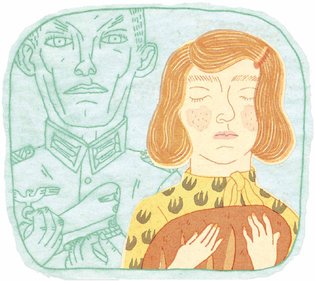
It’s easy to see why Andrea Levy’s 2004 monstrously successful Small Island was turned into a BBC mini-series. It has all the right stuff: historical fiction setting of post-WWII London, heady and illicit romance, examination of societal changes in race, class and gender through the small and focused familial experiences of one London home. Ditto why it’s so enjoyable to read. Continue reading
Tag Archives: World War Two
Small Island: Of Course this book was adapted for a BBC Miniseries.
Filed under Fiction, Orange Prize, Prize Winner
All the Light We Cannot See: Go For It
I got a book light in my stocking. How appropriate for the late night staying up to read “just one more chapter” of All the Light We Cannot See. The trouble, of course, is that the chapters in this novel are never more than five page long – most two or three – and so resolving to do “just one more chapter” is a promise to still be reading an hour later. Thankfully I’m on holiday and sleeping in is requisite. If you’re not on holiday you might prepare to be stern with yourself, or accept being a bit groggy eyed as this isn’t a story easily put down.
Appropriate, too for the images in the novel. It’s a story with parallel narratives – that of Marie-Laure, the blind Parisian girl who is a prodigious reader and world-creator, and that of Werner, the starkly Aryan orphan with a prodigious talent for electronics, radio in particular. As their two tales unfold against the backdrop of France under Nazis occupation, we get intricately woven and masterfully described scenes and plot moments with richly imagined conflicts and consequences. Symbolism abounds: diamonds, curses, radios and silence, snow-white hair and 20 000 leagues under the sea: it’s all meant to mean something and to mean so much.
It’s tempting to give this an unqualified endorsement, and I do strongly suspect that if you pick it up, you’ll absolutely enjoy the read (I certainly did). I have to admit a certain reluctance, however, as I found two problems: 1. The characters, while compelling for what they do and for what happens to them, are not, on their own, fully imagined or realized. They certainly experience conflict and are called upon to make heroic or challenging choices, they have complex interactions with other characters, but their interior lives remain opaque and stunted. 2. The ending is entirely too tidy for my taste. Resolved. And the leadup – the climaxes – read with the certainty of resolution. In part the flashback structure – we begin in 1944 and move back and forth in time – promises this kind of conclusion, but I suppose there’s also the structural point that we couldn’t create such intricately woven parallel narratives without having them meet (or that certain assurance that we could not put characters with such extraordinary and exceptional lives in such danger and not have some resolution).
My complaints are more a way of saying while this is a book you’ll enjoy reading (much as anyone can enjoy reading WWII fiction, I suppose) it isn’t without problems. Look past these quibbles and you’ll find yourself reading by whatever light you’ve got – probably something backlit and electronic. Which will, I’m sure you know, ruin your eyes and keep you up all night.
Filed under Bestseller, Book Club, Fiction, Prize Winner
Emancipation Day: Race, Passing and Why Read Historical Fiction
I grew up in a small town. Think 800 people. Think rural Ontario. Think white. For a couple of elections, we were the only riding to vote for a Reform Party (the precursor to the Conservative party) candidate in all of Ontario. So imagine the Stop Racism! campaign in my elementary school: when all of my class, including the two black kids in the school (siblings), staged an assembly to declare to the rest of the school that we were stopping! racism! And I really did feel like we were – united – putting an end to the scourge. Whatever it was. Wherever it might be. Around the same time (or perhaps only in my memory) I read Underground to Canada, a YA novel about the underground railroad and Canada’s role in ‘saving’ and ‘rescuing’ American slaves (imagine my dismay in reading The Book of Negroes to be reminded again that the sainted image of Canada as a safehaven might be a tiny bit (just a smidge) exaggerated). All this to say I grew up with an idea that not only was racism somewhere else (America), but race was somewhere else (I certainly didn’t have one).
As I’ve grown this taken-for-grantedness about my race – and race in general – has, of course, changed with the introduction of different experiences, people (and critical theory). And has changed (most perhaps) in the reading of fiction. For instance, in a fourth year seminar (with the great M O’C) I read Nella Larsen’s Passing which shares plot threads and thematic questions with Wayne Grady’s Emancipation Day: what is the difference between race enacted and race inherited? race felt and race imposed? I hadn’t considered the set of questions in this way before reading Larsen, it hadn’t occurred to me that race might be something you could put on yourself, or have put on you by others. Or that being recognized as white – and being seamlessly comfortable being recognized this way – afforded all sorts of privileges, recognized and invisible.
All that said, I’m not sure I’d recommend Grady’s Emancipation Day. While there’s a central conflict – what will happen when Jack(son)’s new white wife discovers that his family is black? – and some interesting detours in discussions of race and music, I wasn’t, on the whole, all that invested in Jack and his journey (perhaps because Jack is an unlikeable character, or maybe because I’m an unsympathetic reader). Though maybe Emancipation Day is worth a read as historical fiction – set at the end of WWII in Newfoundland (not yet part of Canada), Windsor and Detroit – its imagining of post-war era gender politics and economies is rich, so too, its explicit engagement with the ways Canadian (Windsor) race relations differ and don’t from American (Detroit). Or maybe not. (Maybe instead you should read one of Lawrence Hill’s other amazing books, Any Known Blood, which asks – and tries to answer – many of these same questions in a (for me) more engaging or nuanced ways. Just saying.)
The Little Stranger: Ghosts of my Ambi(valence)(guity)
Published just after (like months) the first season of Downton Abbey began, Sarah Waters’ The Little Stranger shares the basic plot features of the show (well, sort of): British aristocratic family falls on hard times after the end of the War (this time, WWII) as they are without fortune, but more importantly without a ‘place’ in a world that has moved past the need for lords and ladies.
Place is significant in The Little Stranger as the deteriorating manor house that forms the claustrophobic setting for the novel parallels the degradation of the family’s wealth and social standing. As a good gothic tale, the creaking house is a character in its own right, taking action – at first to protect and then to threaten – the family and any guests. Further gothic elements of maidens in distress, haunting figures and would-be heroes, The Little Stranger is as much an exercise in genre as it is an exploration of the consequences of changing social mores brought about by economic and political turmoil.
That exploration, while complicated and rich in the abstract, is captured in the novel in the minute interactions among characters, casual glances, waylaid gloves and dogs barking at the wrong time. That is to say, the fascination of changing social attitudes falters under the microscopic and magnified lenses of the novel. I am not ordinarily drawn to pages and pages detailing a parlour visit and the composition of the tea tray. Nor was I drawn to it in this instance. I suspect that if you have interest in the time period, or in ghosts and haunted mansions (or in considering how ghosts might be manifestations of our own interests) and mysteries, you’d enjoy the read.
My complaints registered, I should say that I found the mystery element compelling: how/whether the doctor-hero was, in fact, a murderous villain bent on protecting and seizing both the bodies and ideas of the aristocracy. And appropriately haunting. I’ve come back to did-he, didn’t-he in the days since finishing the book, more as wonder of how deceptive first person narration can be and how capable we are of deceiving ourselves – and the pleasure that comes from both.
Filed under British literature, Fiction, Mystery, Prize Winner

 Literary Vice