The Privileges: Life is easier with money. And other things you already knew.

At one point in my matriculation I had ambition to be an Americanist. I had a giant crush on the writing of Dave Eggers and Jonathan Franzen (which is to say a big crush on justifiably self-confident men/writers) and I thought I could spend all my time reading great big books about American life (as N. well knows, this ambition was short lived and I have since refused on numerous occasions the (allegedly) siren call of David Foster Wallace, Don Delillo and Thomas Pynchon). If memory serves I was mostly preoccupied with the representation of the American family.

Had I read Jonathan Dee’s The Privileges (or had it been available yet – it was published in 2010) I’d probably have added it to my list of novels preoccupied with the American family, the American dream, American life. The jist? The American dream lives! Sort of. True love exists! Sort of.  Here’s the plot: novel open with Adam and Cynthia getting married. Their marriage is funded by Cynthia’s step father (her real father being something of a cipher). They have little money, but much ambition, much sense of entitlement for something more. Chapter close. New chapter opens several years later (consistent leaps of time allow for dramatic changes in circumstance in this novel) with Adam working at a hedge fund and Cynthia at home with two small children – April and Jonah. Cynthia isn’t fond of being a full-time parent. Adam figures out that by insider trading he can make a lot of money. And nobody gets hurt, right? Chapter close. New chapter opens several years later when Adam has – after stealing via insider trading – made heaps of money and opened his own hedge fund. Children want for nothing and are maybe getting a bit snobby as a result. Cynthia remains bored. All that they have is deserved. Chapter close. Several years later. Family wealth now rivals that of a small country. Cynthia has opened a charity. The children suffer from ‘lack of authentic experience.’ I keep waiting for someone to either go to jail or be cannibalized.

As I write this I realize that I didn’t really like the book. I thought I did. I enjoyed reading it because it’s lush. For the same reasons I like watching movies where no one wants for anything, everyone looks polished and fashionable, the houses have the latest technology and sleek design. Because it’s the life the dream promises and makes it out like everyone can have so easily (just put it on the credit card, right? because you’re entitled to that life and if you don’t have the money for it now you will in a few months). The book knows it’s being lush. It purposefully trying to send up and explore  this idea of entitlement (how much more transparent can this attention get than the title). I guess I just felt that the novel got a bit distracted by itself:  the flash of well coiffed women distracted from its own critique. The gloss from the substance.

Speaking of well coiffed women: another similarity with Franzen, the women in this novel are wooden and flat. With ample opportunity for character development – these characters do not lack for conflict-driven-change – both mother and daughter read as predictable and lacking in nuance.

So… where do I land? It’s a pleasure to read in a sort of aspirational I too want to be wealthy enough to buy a pony while also pleasurable for the disdain we (masses) can hold the rich that sort of privilege is disgustingly self-indulgent (even in charity – a thread the novel readily picks up). But when you stop to look beneath the gloss, examine beyond the flash, we find… it’s not that great.

Leave a comment

Filed under Uncategorized

Sorcery: Reading Games; or how I read something other than a novel

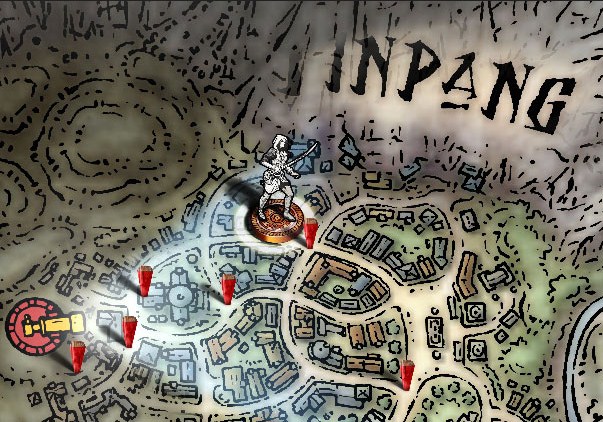
Thanks to another GPW reader request, I found myself “reading” in an entirely “novel” way (haha – reading? novel? hilarious). The suggestion was for me to invest in a $5.99 tablet-based game “Sorcery!” and “read”/”play” the game. the book. the gook. the bame.

Before I tell you about my reading experience and my impressions of the text let me tell you about the text itself (already realizing how reading a non-traditional text is prompting me to right a non-traditional blog post. Normally I’d dive into telling you my impressions of the merits of the work, but somehow in this instance I feel like I need to give you a version of a plot summary.

So what’s “Sorcery!”? My impression (caveatcaveatcaveat about this being my first book/game): It’s Choose Your Own Adventure, meets RPG, meets fantasy. The game begins with character selection (but mercifully free of the tedious selection of hair colour or wardrobe). Once selected the text appears describing the character’s circumstance (aka: the conflict) in which the character (now *me*) must journey across the land to warn some people about an impending attack. To get there my character has to also battle some dragons (which can only be killed after collecting clues and objects-of-dragon-slaying). This little plot summary would be entirely different – or perhaps incrementally different – depending on the choices you might make playing the game. The real delight for this chronic-second-guesser and terrible-decision-maker is that you can ‘rewind’ the game at any and all points to go back and make different decisions to see how the narrative changes. It takes the impulse of childhood Choose Your Own Adventure flipping-back-and-forth and brings it to the digital space with slightly less ease and slightly more satisfaction (there isn’t the instant and you died that so dominated the CYOA of the past).

You might be wondering how does this game differ from other digital efforts at narrative/game hybrids. And in this respect I have very little to offer. I recall reading Patchwork Girl in a MA course in visual culture (think graphic novels) and this game reminded me of that experience – the sort of confab of visual/text/reading/viewing. I would say in this game there’s more reading than viewing, more decision making than passivity. Less empathy for a character’s circumstances than desire to beat dragons (which suggests the game has, after all, achieved its aims in that I am embodying my character rather than vicariously observing and empathizing).

I do look forward to an experience of reading/playing such a game that isn’t set in the fantastical realm. I suspect the power of identifying with a character through RPG and coupling this with the intensity offered by narrative would – in a narrative set in the realist realm – offer a different (if not more vibrant) empathetic experience.

Leave a comment

Filed under Reader Request

A Tale for the Time Being: You Probably Haven’t Heard Of This Book; Here’s Why You Should Read It

Or maybe you have heard of Ruth Ozeki’s A Tale for the Time Being. After all, it was shortlisted for the Booker Prize, hyped in all of the right places. All the same it slipped through my Canlit net, and seems to have for all those I’ve talked about the book with as I’ve been reading it, and so I’ll assume you haven’t heard of it either (you’re my made-up audience, so I may as well, right?).

This idea of the reader-audience and how readers make novels mean something by reading them is one of the (many) preoccupations of this fantastically rich and layered story. At one point our protagonist-cum-author notes “Surely a reader wasn’t capable of this bizarre kind of conjuration, pulling words from the void? But apparently she had done just that, or else she was crazy. Or else… Together we’ll make magic… Who had conjured whom?” (392). The role of reader in the novel is complex: with two threaded narratives – that of Ruth, an author living on an island in British Columbia who finds a diary washed up on the beach and that of the diarist, Nao, an American-Japanese schoolgirl – that both reflect, influence and respond to one another, one of the questions the novel asks is how readers determine and impact the meaning and influence of a story. Within the novel itself this question is explored in the relationship between Ruth and Nao, but the novel expands this question with metafictional play and probity to include this reader, too. So you ought to read it because the novel presupposes its existence depends on your reading it.

You ought to read it because the philosophical questions it explores like the nature of time and quantum mechanics; the role of animals in the interconnected web of being; restitution, responsibility and war; the relationship of class and identity (and bullying); the purpose of art and art-making; – are those questions that make both for great dissertations and for great discussions (and I know you have a thesis you want to write or a book club to attend [*cough* this was a book club choice for the book club I attend]). These questions look esoteric when I write them down, and there are moments of the novel – like reading the Appendixes on Schrodinger’s Cat – that stray in that direction, but the overwhelming feeling this novel evoked for me was exhilaration: it’s simply thrilling to see a masterful exploration of questions of time, identity and the nature of meaning in life through grounded (if somewhat fantastical) story.

And you ought to read it because I say so. Okay, not that. But because it’s beautiful.  Layered with complexity and richness, yet not so dense as to be inaccessible or off-putting. And you see it and think 400 pages, really? And I say, consider the time it takes to read. No really, consider “time” and “takes”: what does it mean to “take time”? Once you’re asking that question you may as well be reading the novel because in reading you find time, time-taking, time-making – well, you might have a different feeling on the other side (which assumes you ever leave a novel once you’ve read it… another question for another time being).

1 Comment

Filed under Book Club, Canadian Literature, Fiction, Prize Winner

Twelve Steps to a Compassionate Life: What Happens When a Nun Quits Religion

I’ve started going to *church. Don’t panic. I’m still an atheist: it’s a Unitarian church, so my minister is an atheist, too. If you thought all us athesists were just running around eating babies you might not have realized that I (certainly don’t want to speak for all athesists) do believe in things – I just don’t believe in God, an afterlife, divine-whatever. Instead I believe in community, in our collective and individual need to make meaning. Anyway, this year the congregation has been reading Karen Armstrong’s The Twelve Steps to a Compassionate Life and many of the sermons have picked up on themes from the book. Wanting to be the best at church (and earn a gold star at the optional book group discussion) I overcame my instinctual resistance to non-fiction and to a book that appeared – at first – dangerously self-helpy (a post for another day on my objections to self-help books) and gave it a go.

The twelve steps can be neatly summarized (and are by Armstrong) in “do unto others as you would have done unto you.” What makes it an interesting read from a religious studies perspective is the lengths at which Armstrong goes to include a diversity of religious perspectives (though no Unitarians?) on the “Golden Rule”. Her attempt to illustrate the similiarities among not just religions, but a sort of common humanity that has, as part of its nature (she argues), compassion, empathy and care, leads her to close readings of a range of religious, political and literary texts. Each chapter offers a “step” on the path to a more compassionate life. Steps like “empathy,” “self compassion,” or “understanding the limits of our knowledge” and “learning more about others.” With each step she offers daily exercises for extending compassion (indeed she makes a repeated comparison between training for a race or a ballet, and training compassion – that is, she suggests compassion is both an inherent quality and one that needs to be cultivated) like meditating on an enemy and extending to that enemy care and empathy. Of all the steps I found the chapter on ’empathy’ most resonant, and probably because it urges reading literature as a possible means to grow empathetic understanding (a repeated argument I’ve made here on the purpose of reading).

So what did I think of the book? Would I recommend it? I think Armstrong’s belief that we can learn to be individually – and collectively – better at caring for one another is a powerful, if only partially persuasive one. I found the first chapter that provides an overview of how Confusianism, Buddihism, Christianity, Islam and Judaism have understood and practiced ‘compassion’ a potent reminder (and a flashback to first year religious studies) of the similarities among these faith groups, the consistency in their fundamental belief in communal care. I did find that many of the later chapters – five or six pages in length – slipped into something of pat directives to be kinder to other people, to not assume you know everything. I would say that as a non-believer the book was both accessible and non-preachy. I don’t know. Read it if you find yourself frequently overcome with frustration at work: when you can’t stand another meeting, or your boss has just finished explaining the difference between a word document and a pdf for five minutes. You might find then that some of the calls to compassion are helpful, even healing. You may also find lobbing the book at the wall an equally restorative exercise. You be the judge.

Leave a comment

Filed under Non-fiction, Prize Winner