Category Archives: Book Club

Adult Onset: What you need to know about being a parent (without having kids)

I’m not a parent. Most of the significant members of my social circles have become parents in the last year or so (friends, colleagues, siblings). It’s been hard at times to be the child-less 30-something among a seemingly ever-expanding network of parents. Sure you say, they don’t stop being siblings or friends, and you’re right, they don’t, but they become something else, too. And in becoming, add to their vocabularies, stories and frames of reference experiences that I can only imagine and witness: baby-led weaning, sleep training, pumps, exhaustion and marital discord. At this point in my life I am interested in parenting in the way I am interested in filing my own taxes: I’m conscious of the merits of taking part, wary of the responsibility and the risk of fucking it up, and secretly suspicious that the claims of it being ‘so hard’ are overstated.

Anne Marie MacDonald’s Adult Onset takes up these questions about parenting by following one parent – Mary Rose – over the course of a week as she grapples with the tensions of raising kids in the particular moment of yuppy, 2014, Toronto. Okay, so the particular moment of 2014 Toronto, but also Mary Rose’s own experience as a child and how her relationship to her parents colours her self-conceptualization and realization of her own identity as a parent. That is to say, there’s a bit of past-present blurring and Mary Rose-and-her-mother blurring  throughout.

It would be oversimplified to say her understanding of parenting is ‘fraught,’ but it is. Her parents experienced miscarriages, stillbirths and the death of a child; these experiences contributed to postpartum depression that necessarily impacted the way Mary Rose experienced her own childhood and the way she conceptualized what the acceptable activities and attitudes of parents include. Mary Rose and her partner Hillary raise an adopted child and a biological child (for Hillary, but not for Mary Rose), complicating in the novel how biological connections shape – and don’t – parenting. They’re also lesbian parents in a 2014 Toronto that has legalized gay marriage and (as of yesterday) introduced gay marriage into the curriculum, but still encounter tension in the representation and construction of normalized ideas of ‘family’ and ‘parent’. Add the complications of parenting in an era of anxiety, hyper-vigilance and over-protection (I recently read and enjoyed Hanna Rosin’s “The Overprotected Kid” which is well worth a read if you’re interested in how surveillance culture is impacting parenting norms). Add to that the week depicted is one in which Mary Rose must parent “alone” as Hillary is away.

I’d probably have enjoyed Adult Onset a lot more if I wasn’t currently surrounded by new parents. Don’t get me wrong – I love the babies in my life and the parents raising them. I don’t mind – in fact, I usually enjoy – hearing about teething, naps, day care and the toll it takes on the body.  At the moment I’m invited to watch and to listen the transformation and power of parenting in my real life, and so the opportunity to do the same in a novel is – while beautifully rendered, full of complication and nuance, exceptional writing and strong characters – not immediately exciting. But it was a great read and will – no doubt – lend itself to a rich discussion at the next book club (where, yes, I’m the only non-parent).

2 Comments

Filed under Book Club, Canadian Literature, Fiction

City of Light: ‘Allegory’ doesn’t mean what you think it does. Or what I think it does.

The thing about an allegory (like a metaphor) is that the comparison is made between two unexpected things (pigs and communist leaders; shadows on the wall and ideas). So when reading Lauren Belfer’s excellent City of Lights I struggled to figure out whether the novel was allegory or something else. A literary term that escapes me, but exists, I’m sure.

So tell me what this literary term is that I’ve missed out on. I’m looking for a term that describes when the fictional plot events/setting/character parallels a contemporary and real plot event/setting/character. Not parallels in an unexpected way, but parallels in a way you recognize the contemporary thing. You’d like an example? Sure.

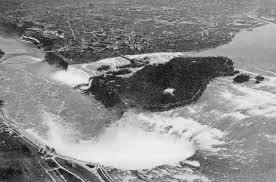
So a bit to set this example up. The novel is a few things: historical fiction, murder mystery, romance, tragedy of manners. The plot goes something like this – it’s 1901, Buffalo is playing host to the pan-american exposition. Industrialists and engineers are developing hydroelectric power at Niagara Falls with all sorts of complications: union organizing and labour conditions; nature-preservationists and eco-terrorism (that the development of the Falls was protested on environmental grounds was an absolute revelation to me); public versus private ownership of resources. Our protagonist, Louise Barrett is headmistress of an exclusive all-girls school and passionate about the way education can transform individual women and reform society as a whole. She’s also afforded unusual social liberties because of her ‘spinster’ status; a status she’s had to assume for good reason (which I won’t spoil here) to do with gender-based violence and independence for women. A man gets murdered. The hydroelectric project gets complicated. The cast of characters and their secrets and lies thickens.

Right, so in this example Louise is talking to a reporter (masquerading as a photographer – because performativity and identity is also a big thing here), Franklin (who is also a potential love interest). Franklin explains his cynicism as to why he doesn’t think the industrialists care about the ordinary people when the choice is between the people and the extraction of a resource:

I served time in the Philippines, remember? I saw our fine and honorable American soldiers using the too-aptly named ‘water cure’ to exact confessions from prisoners; of course the prisoners weren’t ‘white’ so it didn’t matter. (135) He goes on… Electricity should be a public service, not a commodity sold to the highest bidder. The electricity created at Niagara belongs to the people. Not to the industrialists, not to the nature preservationists […] but to the people” (136). 

It parallels waterboarding, right? Electricity – throughout – parallels oil extraction with immediate gains prioritized over long term environmental damage. But it’s not an allegory because it is – in the fictional past – a recognizable reflection and deepening of our understanding of the present. Am I just describing a term called ‘the beauty and wonder of historical fiction’?

Anyway. I really loved this one. The murder mystery, while a driving plot point, wasn’t the focus of the text so much as Louise’s journey to understand her past and present. The historical details about Niagara and hydro development are genuinely fascinating. The socio-political-economic context that underpins the plot is as rich a character in its own right as any. Including the one moment Louise doubts her self-reliance and thinks how lovely it would be to rely on a man, she is a model of feminist independence. So yeah, please read the book and tell me what the term is that I’m looking for. Or maybe you don’t have to read the book because it’s so obvious. It’s probably alliteration. Kidding. (Am I?)

Leave a comment

Filed under American literature, Book Club, Mystery, Prize Winner

A Man Called Ove: How to tell if the book you’re reading is sentimental crap. Or if you are cruel and unfeeling.

I’m a graduate of a PhD program in English and Cultural Studies. My training was all about – well, most of the time – explaining why something was bad. Oversimplified! (see? I’m good at explaining why I’m bad, too). What it was about was cultivating my critical faculties. My ability to take something apart and show all the ways it was ‘problematic’. There’s a whole set of verbs you can use: problematize, trouble, unpack… all in an effort to have us reconsider the taken-for-granted and the assumed. Sometimes I worried – like L. – that I was being trapped in a culture of criticism that not only meant I had a harder time building or believing in something (that is, being earnest or sincere), but that I was only ever to think about the books I was reading in terms of ‘good’ books (those that were self-aware enough to know they were problematic) and those ‘bad’ books.

So I’m tempted to say that Fredrick Backman’s A Man Called Ove is problematic, but I’m not going to (even though I just did, see?). Instead I’ll say that it’s at once wonderfully enjoyable and a lesson in the conventions of best-selling novels: a story of a man who tries to kill himself because he’s grieving the death of his wife, but can’t kill himself because he finds purpose in building community (how’s that for the elevator pitch?).

The chapters read as headlines (“A Man Called Ove Finds a Screwdriver” “A Man Called Ove Buys Bread”) (which I recently learned is a pretty common strategy in writing a novel, to sketch out your chapters as newspaper headlines) and the narrative – in translation, no less – is funny, warm, cozy and safe. You’re meant to see Ove as his neighbours do, a crotchety old man who is actually the funny, warm, cozy and safe man that parallels his narrative.

It’s a book I’d suggest if you were worried that living in your townhouse in the suburbs was making you less community-focused. Or if you thought that maybe you couldn’t have intergenerational friendships. Or if you were concerned that you were xenophobic or homophobic (or that maybe your granddad was). It’s a book that takes any worry you might have about your existence – or modern life – and banishes it away with the calmest, safest, warmest, funniest, hug-of-sentimentality.

It’s a book you’ll read and you’ll cry in your oatmeal. You’ll be glad you read it for the warmth it gave you all day. You’ll read it knowing there are problems with the narrative construction, with the character, with the politics of the text, but you won’t mind because it makes you feel so good. And whether that makes the book itself good or bad, I’m not one to say. I think there are some occasions (certainly not all, let’s not get carried away), when it’s okay to enjoy a book because it’s enjoyable. And this one really is.

6 Comments

Filed under Book Club, Fiction, Funny

How to be Both: Gimmick or Genius?

Ali Smith’s *How to be Both* has a bit of a gimmick. The book is divided into two, free-standing – if entirely inter-related – halves: “camera” and “eyes.” In half of the books printed and sold the section “camera” begins the book; in the other half of the books printed and sold the book begins with “eyes.” Whether you pick up a book that begins with “camera” or “eyes” is entirely chance (unless, I suppose, if you went looking for a particular starting point). One of the questions the book asks, then, is how the framing of a story – its order, narrator, what you already know about the story – changes its interpretation. It asks the question in its form – camera or eyes? – but then throughout as we explore how a teenage girl grapples with her mother’s death and asks similar questions about what she can know about her mother, what she can know about what her mother saw and did, based on the remaining frames and her memory. So, too, we explore it in the the story in the realm of art and art history, asking what we as viewers bring to an interpretation, whether our own biographies or our own sense of what the picture ought to mean based on where it is placed (a gallery or museum), what it stands next to, the notoriety of its painter, the legacy of the work.

While reading How to Be Both and knowing the split – the purposeful division and the call to think about how stories are framed in the very structure of the narrative – this reader couldn’t help but – and here’s the genius of the book (or the gimmick?) ask how my interpretation was inevitably being shaped, purposefully being manipulated by order. So of course I’m more attached to the first half of the book (I read it with “Eyes” beginning) because this is the story that came to me first, that I attached to first, that I connected with first (obviously primacy has some resonance for me). I can’t possibly know now – without magic, that is – how I’d react if I’d read “Camera” first – I certainly tried, knowing it was impossible, to hold these two ideas in balance at the same time. It is, then, a sort of formal-genius to use the form to so brilliantly work at the reader’s engagement with the content.

On the content – knowing I can’t really separate here (or ever) from the form – I’m less inclined to declare genius and more to say very good. There’s something playful in the absences of dialogue tags and curious disorientation as we’re dropped into the middle of an already unfurling (and recoiling, and reverberating) story, working as detectives to figure out who characters are, what the plot threads are, where we are in time and space  (what genre we’re in, for that matter). It’s playful but also a lot of cognitive work to keep the layers and threads in order – or in purposeful disorder – as well as to be mulling the formal qualities and the readerly tensions. It’s like we have to be both immersed in the narrative and outside the text considering how our reading is shaping the meaning. We have to be both as readers reading about how to have two things that you can’t have at the same time happen at the same time. Not that play can’t be work (or vice versa), just an alert that you may want to read this one fully focused and not in short bursts – it’s not something that you can read two pages of, put down and come back without re-reading those two pages. So read it, but read it slowly and watch while you also experience the genius of form-content-reader-interpretation happen to you while you read about.

2 Comments

Filed under Book Club, Fiction, Prize Winner